What does "lifting heavy" actually mean for women?
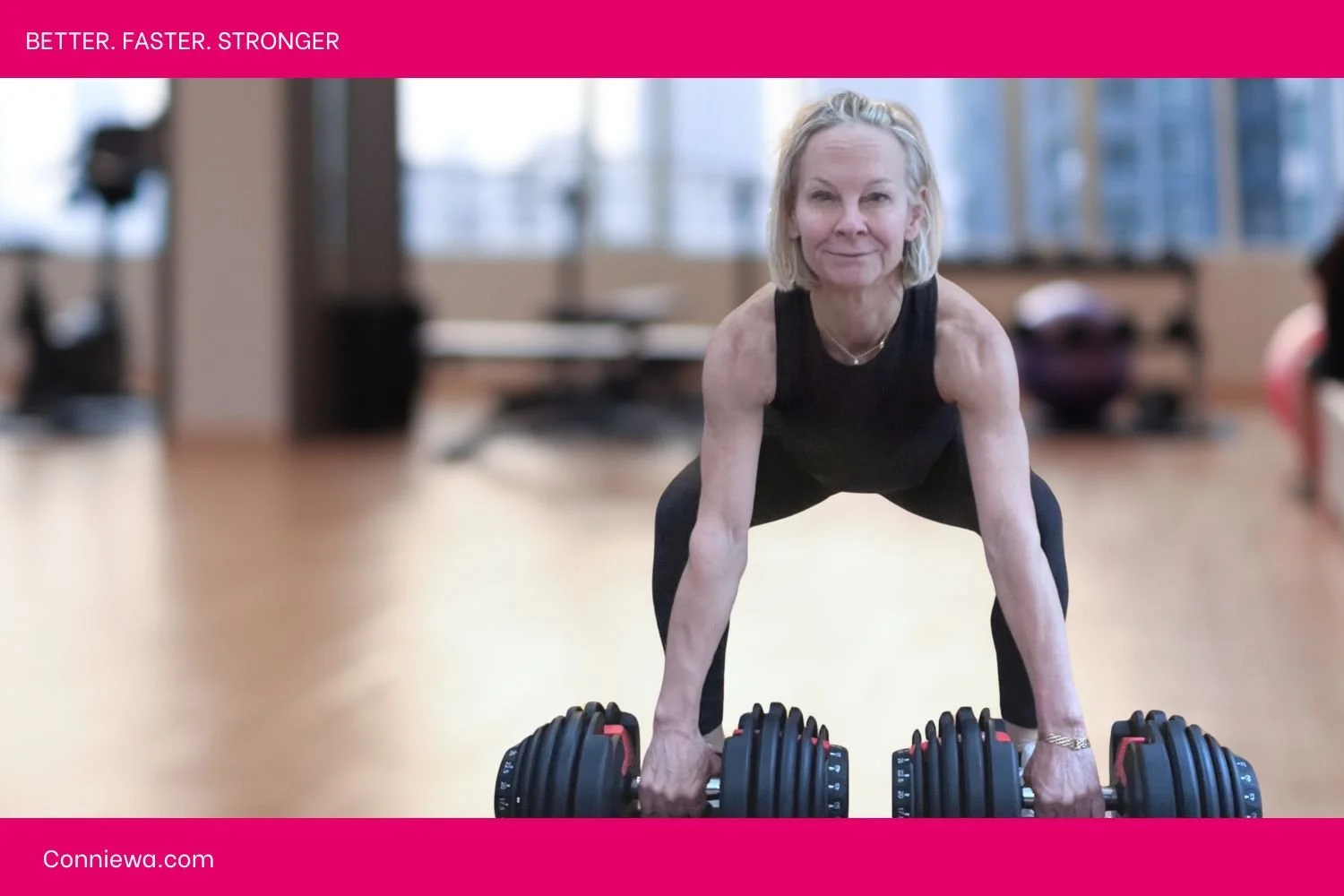
I used to measure a good workout in sweat. Soaked = success. I ran, took classes, played tennis, and as a general approach to staying active, it worked.
But about two years ago, my social feed started telling me that women need to lift heavy. My immediate reaction was — no thank you. I pictured bulging muscles, complicated programs, and intensity that didn't feel especially appealing.
It turns out, that's not what it means.
The Facts About Muscle Loss in Women
After 30, women lose roughly 3 to 5 percent of muscle mass per decade. That number does not sound alarming until you factor in what else is happening: we sit more, play fewer sports, and tend to opt for gentler exercise. We also get injured more, and when activity decreases, muscle loss accelerates. Researchers call this sarcopenia. Most of us just call it feeling slower, stiffer, and more tired than we used to.
Losing strength is a self-defeating cycle.
Building strength is how you reverse it — and how you open up possibilities rather than close them down. For women over 40, this is not optional maintenance. It is how you stay in the game.
Why Most Workouts Have a Ceiling
Many of the classes and routines most of us rely on are excellent maintenance programs. You show up, you know what to expect, you work hard. But maintenance has a ceiling. The same routines, the same weights, the same level of challenge week after week — your body stops adapting. Maintenance is not nothing, but most women in midlife need to be building, not just maintaining.
Building strength requires progressively increasing the load and the challenge — a little more than last time, consistently over time. When a muscle is exposed to enough challenge, your body adapts by becoming stronger. This is called progressive overload, and it is the engine behind every effective strength training program for women.
Will Lifting Heavy Make Me Bulky?
I know this is on your mind.
Women do not accidentally build large muscles. That kind of development takes years of specialized training, very high volume, specific nutrition strategy, and often exceptional genetics. It is not going to happen to you by adding weight to your squats.
What will happen: you will get stronger, feel more capable, and move better. That is it.
So How Heavy Is Heavy for Women?
There is no universal number. Heavy is relative to you, on this day, in this movement. A useful rule of thumb: your sets should feel like a 7 or 8 out of 10 in effort. Challenging enough that you could do two or three more reps, but not ten. This is the zone where adaptation starts.
One more thing worth knowing: in the first eight to twelve weeks of strength training, most women feel stronger surprisingly quickly. Your nervous system adapts fast, and you feel progress before you see dramatic physical change. Those early weeks are motivating for a reason.
Strength begins when you shift from maintenance mode to challenge mode.
Lifting heavy simply means choosing a load that asks a little more of you than you are used to.
Doing something is always better than nothing. But doing a little more than last time? That is where change happens.
Try This: The Good Morning
The Good Morning is one of the simplest ways to learn the hip hinge — a foundational movement pattern for almost everything that involves strength training for women.
Stand with your feet hip-width apart and a soft bend in your knees. Place a broomstick or similar behind your neck and hold with palms facing forward. Push your hips back, keeping your spine long as your torso tips forward. Return to standing by driving your hips forward.
You should feel this through your hamstrings and glutes — the posterior chain that supports your lower back and powers most real-world movement: picking things up, climbing stairs, moving with more ease and less strain.
Do 3 sets of 8–10 slow reps, resting about 45 seconds between sets. Start with bodyweight. The goal is awareness and control.
Once the pattern feels solid, this is one of the first movements you can begin to load. Master the pattern first, load later.
— Connie
Strength & Performance Coach
Better. Faster. Stronger.
Connie Wansbrough is a Strength & Performance Coach based in Toronto. She helps high-performing women get stronger and discover what that does for everything else.
Subscribe to her bi-weekly newsletter BETTER. FASTER. STRONGER. here: [link]
