Can you jump your way out of osteoporosis?
This seems to be the topic du jour on social. If you are over 50, you need to immediately start jumping and you will reap a myriad of benefits including stronger bones, a longer life, and less annoying people around you. (Hehe.)
Seriously?? Have any of these health influencers had a vaginal birth? Have they hit menopause? The pelvic floor just is not as well... resilient as it used to be 😬.
And, has anyone tried jumping with arthritic knees or feet, the price some pay at 50 for having been a competitive dancer or athlete at 18?
Here is the truth, from a strength-building lens.
What the research says
Jumping programs reliably increase bone density. Bone is living tissue and responds to mechanical force. The research is strong and consistent for premenopausal women.
For postmenopausal women the picture is murkier. Several studies found that the same jumping programs that work well before menopause showed no measurable effect on bone density after it. Why the results differ isn't fully settled, but the practical takeaway is clear: what works for a 30-year-old doesn't automatically work the same way for a 55-year-old.
However, single leg hopping (comparing one leg that hops against the other that doesn't) within the same woman, has been shown to build hip bone density specifically in postmenopausal women. This is different and more demanding than the casual jumping being promoted online, and it is not appropriate for everyone.
And the pelvic floor problem is real. For women with any pelvic floor weakness, from childbirth, menopause, or prolapse, jumping without proper conditioning can make a bad situation worse, not better. This detail is conveniently missing from every "just start jumping" post on your feed.
What actually builds bone?
Heavy resistance training is the most well-supported strategy available for maintaining and building bone density in this group, and it's also exactly what this newsletter has been telling you to do all along. Squats, deadlifts, step-ups, loaded carries. For most women this is a safer and more sustainable entry point than jumping.
Stair climbing also counts.
Your sport matters too. Tennis, pickleball, hiking, running and dance all involve the kind of weight-bearing or multidirectional movement that loads bone well. Cycling and swimming are excellent for your heart but provide little bone-loading benefit since your body weight is supported by the bike or the water. If that is your primary activity, the resistance training above matters even more for you.
Also, if your pelvic floor is not solid and you want to add impact, consult with a pelvic floor physiotherapist first. More on pelvic floor strength specifically in a future issue.
One thing to do: The Heel Drop
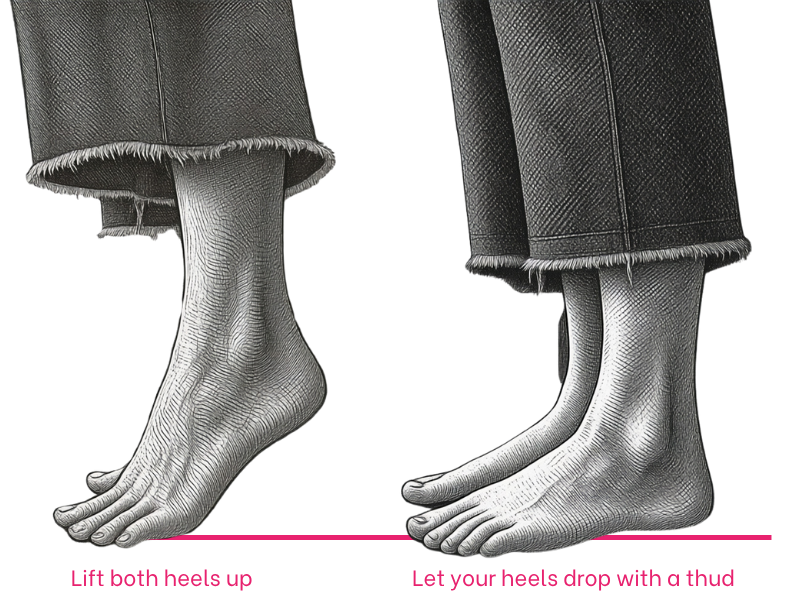
Find a firm, flat surface to stand on.
Rise up onto your toes, then let your heels drop back down to the ground with controlled force.
This is a deliberate drop, letting your body weight fall with gravity.
You should feel and hear a definite impact through your heels.
Keep your knees and hips straight throughout.
This is a drop not a calf raise!
10-15 reps, 2-3 times a week.
Watch this exercise on Instagram
**This is a studied bone-loading exercise that targets your hip and spine the two sites where fractures matter most. It is gentler than jumping and far gentler than running, and it does not carry the same pelvic floor risk because there is no airborne phase.
One important caveat: this exercise loads through your toes and forefoot on the rise. If you have arthritis in your toes or feet stick with resistance training.
